M25
OrbitalLondon Orbital
117 miles around the capital — the UK's busiest motorway. Largely smart-managed with variable speed limits.
Around 2,300 miles of motorway carry roughly a fifth of all UK road traffic. Knowing the basics — signs, lane rules and smart-motorway signals — keeps you safe and out of fines.
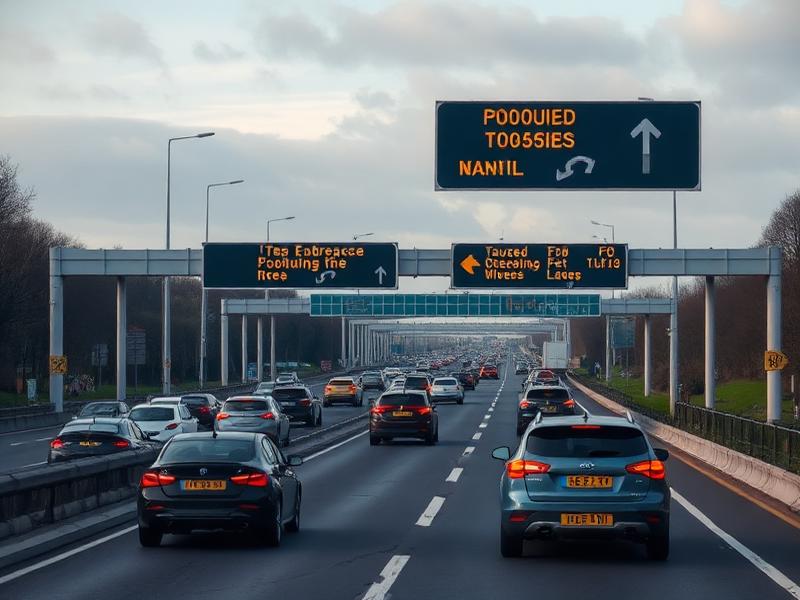
UK motorways are designated with the prefix M (e.g. M1) or A(M) for short upgraded sections (e.g. A1(M)). The national speed limit is 70 mph for cars and motorcycles, 60 mph for cars towing trailers, and 60 mph for HGVs.
Smart motorways use overhead gantries to vary speed limits, close lanes (red X) and on some sections turn the hard shoulder into a running lane. As of 2023, new all-lane-running schemes have been paused, but existing sections remain in use.
117 miles around the capital — the UK's busiest motorway. Largely smart-managed with variable speed limits.
193 miles. The original UK motorway, opened 1959. Smart-motorway sections between J10 and J39.
232 miles — the longest UK motorway. Connects the Midlands, North West and Scotland. Includes the M6 Toll, a 27-mile bypass of Birmingham.
Privately operated. £8.50 for cars (peak weekday). Pay at toll plazas — cash, card or tag. Useful for avoiding M6 congestion around Birmingham.
189 miles. Connects London with the West Country and South Wales via the Severn Crossings.
163 miles. The main route to the South West — and famously congested at summer weekends.
Central Scotland's main artery. Tight urban sections through Glasgow with frequent slip roads.
Trans-Pennine motorway. Reaches the highest motorway point in England (372 m) at Windy Hill.
55 miles. Main route to Stansted Airport and Cambridge.
An alternative to the M1 via Oxford. Less congested but slightly longer.
Continuation of the M6 into Scotland. Free, fast, and the main route between England and Glasgow.
Main route to the Channel ports and Eurotunnel. Subject to Operation Brock contraflow during cross-Channel disruption.
On smart motorways, a red X above a lane means that lane is closed. Driving in it can result in a £100 fine and 3 penalty points.
Stop on the hard shoulder only in a genuine emergency. On all-lane-running sections there is no hard shoulder — use an Emergency Refuge Area.
Many roadworks and smart sections now use average-speed cameras. The displayed limit applies until you pass the end sign — not just at the cameras.